Two inputs instead of an open CAD editor
The end user needs a fit path, not access to the model’s entire parameter space.
A guardrailed sizing workflow links user measurements to an Excel design table, a SolidWorks assembly, and 19 STL outputs per recorded variant.

Wheelchair and scooter frames vary. A fixed clamp cannot serve that variation, while manual CAD editing makes every new fit expensive and dependent on the original designer.
I reduced the product interface to two user-supplied diameters. Those values enter a design table, drive a parameterized SolidWorks assembly, and produce a complete set of printable files.
The implementation boundary matters: the web and export code was AI-assisted. This case demonstrates product definition, CAD parameterization, workflow orchestration, and validation. It is not presented as proof of unaided Python authorship.

Accept millimeter and inch inputs
Constrain wheelchair diameter to 18–32 mm
Constrain scooter diameter to 12.7–33.02 mm
Update a canonical two-variable design table and rebuild the assembly
Export, group, name, and package a complete set of STL files
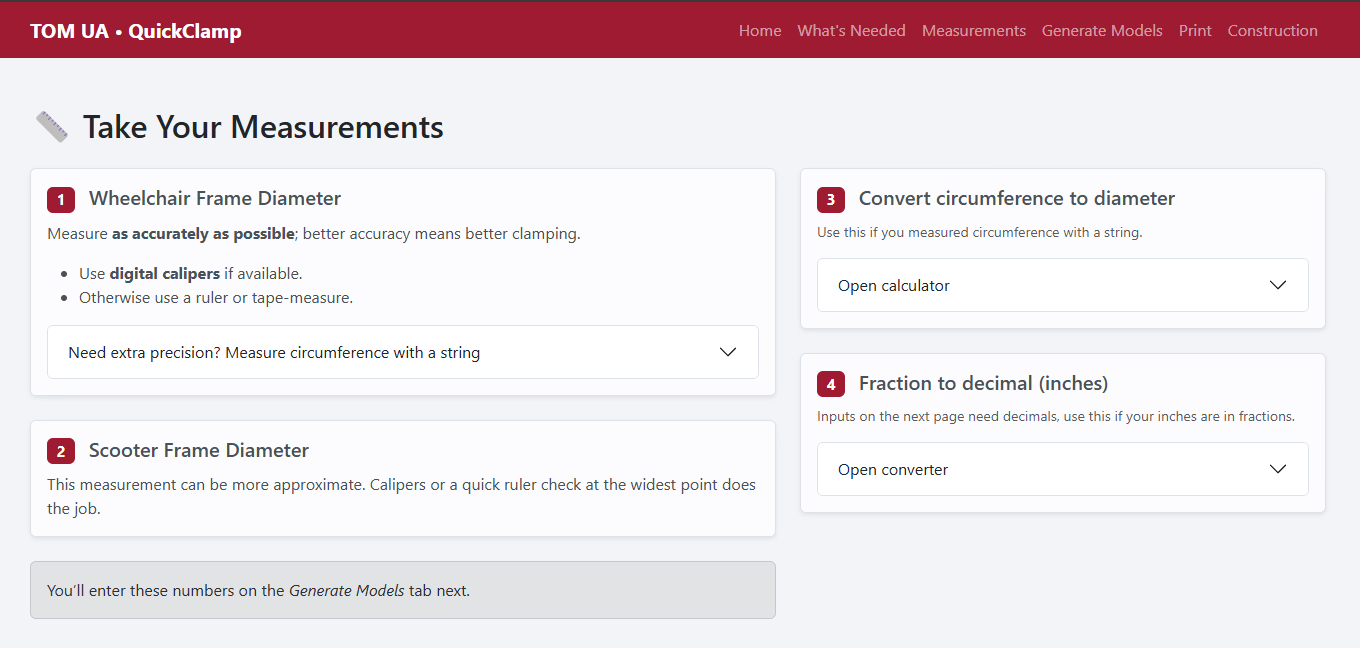

The end user needs a fit path, not access to the model’s entire parameter space.
Wheelchair inputs are constrained to 18–32 mm and scooter inputs to 12.7–33.02 mm in the recovered workflow.
Each generated configuration is named, grouped, and zipped so the assembly remains coherent.

Achieved · individual
The source workflow accepts wheelchair diameters from 18–32 mm and scooter diameters from 12.7–33.02 mm
achieved
Achieved · individual
Each recorded export folder contains 19 STL files
achieved
Achieved · individual
The local artifact archive contains 30 generated output directories across several tube-diameter combinations
achieved
Support tube variation without manual remodeling
Guardrail two measurements and drive a parameterized assembly
30 recorded output folders; 19 STL files in each audited folder
Identify physically tested variants and harden the Windows/SolidWorks automation path
Which recorded variants completed physical fit testing
Production reliability of the Windows/SolidWorks automation path
A public-safe, maintained deployment of the generator
A custom product becomes more useful when the customization itself becomes a system.